TOPIC: UNICODE
Resolving a Linux Mint and Windows keyboard shortcut conflict encountered when using SAS Enterprise Guide in a remote Citrix session
 20th February 2026
Here is a gotcha, slight though it is, that caught me when working in SAS Enterprise Guide on a Windows system to which I was connecting from Linux via Citrix. What I wanted to do was use the keyboard shortcut CTRL + SHIFT + U to convert text to upper case in the program editor, only for it to produce a black square and nothing else.
What I was encountering was a clash in keyboard shortcut assignments. On Linux Mint, CTRL + SHIFT + U activates Unicode character input mode. The black square was there for me to enter a hexadecimal code to add a character that my keyboard would not facilitate in normal circumstances. While the facility clearly has its uses, it was getting in my way and a solution had to be found.
Taking the simple route, I changed the keyboard shortcut to avoid the clash. Though others may want to go further than this, that was enough for me. At the command line, I issued the following command so that I could accomplish this:
ibus-setup
In the application screen that appeared, I navigated to the Emoji tab. To the right of the Unicode code point box, I clicked on the button with four dots. That led me to another dialogue box where I could change the modifier keys. Thus, I unchecked the box for SHIFT and ticked the one for SUPER (the Windows key on many keyboards these days) instead, before clicking on the OK button to confirm the setting. With that completed, I closed the IBus Preferences screen.
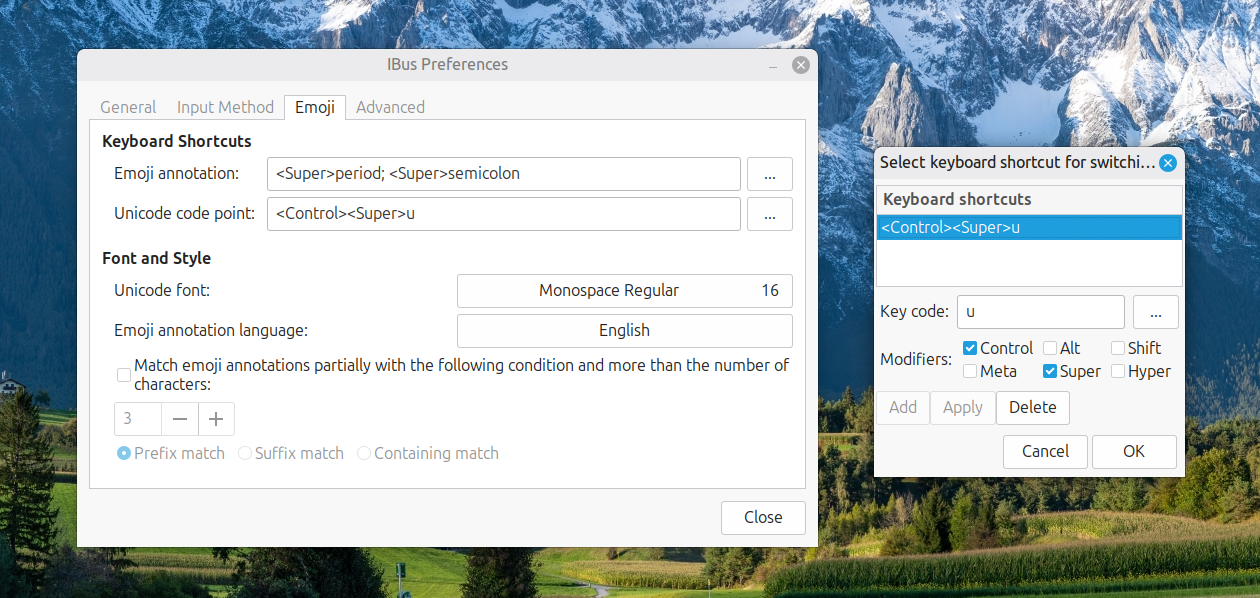
Now, I had CTRL + SUPER + U instead of CTRL + SHIFT + U. This meant that the CTRL + SHIFT + U in Enterprise Guide worked exactly as I expected it to do. A baffling situation had been resolved to leave me working without intrusion.
Resolving Python UnicodeEncodeError messages issued while executing scripts using the Windows Command Line
14th March 2025
Recently, I got caught out by this message when summarising some text using Python and Open AI's API while working within VS Code:
UnicodeEncodeError: 'charmap' codec can't encode characters in position 56-57: character maps to <undefined>
There was no problem on Linux or macOS, but it was triggered on the Windows command line from within VS Code. Unlike the Julia or R REPL's, everything in Python gets executed in the console like this:
& "C:/Program Files/Python313/python.exe" script.py
The Windows command line shell operated with cp1252 character encoding, and that was tripping up the code like the following:
with open("out.txt", "w") as file:
    file.write(new_text)
The cure was to specify the encoding of the output text as utf-8:
with open("out.txt", "w", encoding='utf-8') as file:
    file.write(new_text)
After that, all was well and text was written to a file like in the other operating systems. One other thing to note is that the use of backslashes in file paths is another gotcha. Adding an r before the quotes gets around this to escape the contents, like using double backslashes. Using forward slashes is another option.
with open(r"c:\temp\out.txt", "w", encoding='utf-8') as file:
    file.write(new_text)