Adding Microsoft core fonts to Debian
 18th June 2009
When setting up Ubuntu, I usually add in Microsoft's core fonts by installing the msttcorefonts package using either Synaptic or apt-get. Though I am not sure why I didn't try doing the same thing for Debian until now, it's equally feasible. Just pop over to System > Administration > Software Sources and ensure that the check-boxes for the contrib and non-free categories are checked like you see below.
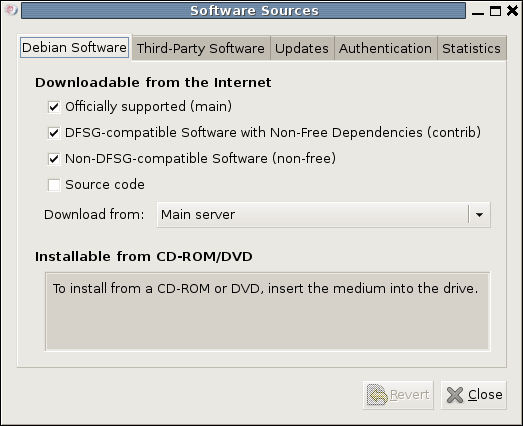
You could also achieve the same end by editing /etc/apt/sources.list and adding the non-free and contrib keywords to make lines look like these before issuing the command apt-get update as root:
deb http://ftp.debian.org/debian/ lenny main non-free contrib

deb-src http://ftp.debian.org/debian/ lenny main non-free contrib
All that you are doing with the manual editing route is performing the same operations that the more friendly front end would do for you anyway. After that, it's a case of going with the installation method of your choice and restarting Firefox or IceWeasel to see the results.
Ridding the Google Toolbar dictionary of erroneously added words
16th June 2009
Butterfingeredness can happen to anyone, and it's always nice to know to remove words added to custom dictionaries in error. Many of my blog postings have had their spellings checked using a button on the Google Toolbar, so I have a vested interest in knowing how to remove any bloomers. Thankfully, they have a useful page telling you exactly what you need to do for Firefox and Internet Explorer. As is often said, you can never be too careful...
Take a great leap forward, then consolidate...
12th June 2009
While I have been a user of WordPress since late 2006, I only began to start keeping tabs on its development following my hearing news of dramatic changes coming in what became 2.5. Since a pattern developing with more significant changes coming in 2.5 and 2.7 while both 2.6 and 2.8 didn't add too much in the way of upheaval but rather evolved what was already there. With 2.8, theme and widget management got the once over, while there were plenty of other tweaks that polished a well received forbear. The differences between 2.7 and 2.8 are discernible without breaking anything that shouldn't be broken. In short, I rather like the result.
The reaction to 2.5 was mixed, to say the least, and that in part led to the dramatic changes in 2.7, especially regarding the administration interface. Now, I admit to having had doubts about these when I first saw them in development, especially when there was so much chopping and changing during development that stepping back until things settled down became a necessity. Even adding a ticket to the TRAC was problematical, unless you had sight of what was happening behind the scenes, because it became too easy to add an invalid ticket.
With the release of 2.8 into the wild, 2.9 is now on the horizon, and I am inclined to suspect that we might see more considerable changes again. For one thing, there was that interface poll a little while ago, so who knows what impact that may have on what comes next. The structure of the administration screens may not alter that much, but it still leaves changes to colours and icons with the aim of separating navigation from what else is on there, something that doesn't trouble me at all. In fact, I don't see very much wrong with how things are right now, which causes me to wonder if there's any point in making too many changes at all.
The forecasted incorporation of WPMU functionality is a bigger change that would mean the end of WordPress MU as a separate entity, and would concern me more with the amount of under the bonnet re-engineering that would be needed. Add Google Summer of Code projects to this mix and 2.9 looks as if it could be a step change in the spirit of 2.5 and 2.7, if not in feel. Summer 2009 could be very interesting for WordPress, leaving me to hope that it continues to work for me in the way that it does as we move from version to version.
%sysfunc and missing spaces
10th June 2009
Recently, I was trying something like this and noted some odd behaviour:
data _null_;
    file fileref;
    put "text %sysfunc(pathname(work)) more text";
run;
This is the kind of thing that I was getting:
text c:\sasworkmore text
In other words, the space after %sysfunc was being ignored and, since I was creating and executing a Windows batch file using SAS 8.2, the command line action wasn't doing what was expected. Though the fix was simple, I reckoned that I'd share what I saw anyway, in case it helped anyone else:
data _null_;
    file fileref;
    x="text %sysfunc(pathname(work))"||" more text";
    put x;
run;
A late "advance" sighting?
6th June 2009
Somewhat infuriatingly, Google released its own browser, Chrome, into the wild near the end of last year, though only for Windows. My experiences with it on that platform are that it works smoothly, albeit without many of the bells and whistles that can be got for Firefox. While an unofficial partial port was achieved using Crossover Chromium and there is the Chromium project with all its warnings and the possibility to add a repository for its wares to Ubuntu's software sources, we have been tantalised rather than served so far. However, that was recently bettered by the release of early access versions. In reality, these can be said to be alpha versions so not everything works, but it's still Chrome and without the need for Windows or WINE. The rendering engine, most importantly, seems to be the equal of what you get on Windows, while ancillary functions like bookmark handling seem incomplete. In summary, the currently available deb packages are a work in progress, yet that's better than not having anything at all.