position: static?
 12th September 2008
CSS positioning seems to be becoming a nightmare when it comes to IE6 support. While I am aware that the likes of 37signals have stopped making their products work with it, there remain plenty of people who stick or are stuck with the old retainer. I am one of the latter because of the continued use of Windows 2000 at my place of work, though a Windows Vista roll-out has been mooted for a while now. If nothing else, it keeps me in the loop for any inconsistencies that afflict the display of my websites. Positioning of an element within the browser window rather than within its parent element is one of these, and it looks as if specifying a position of relative in a stylesheet is part of this. Apparently, it could be down to its non-triggering of IE's haslayout property. Though it might be a hack, I have found that static positioning has helped. While I'll continue to keep my eye out for a better solution if it exists, the static option seems to have no detrimental effect in IE7, IE8, Firefox, Safari, Chrome or Opera.
Dean's FCKEditor for WordPress plugin, a wish list
8th September 2008
Admittedly, I have a liking for FCKEditor over and above what comes as standard with WordPress. Here, the FCKEditor for WordPress plugin has been addressing my preference for a while now. However, its most recent release dates from last April and its integration with WordPress 2.6.x has been leaving a lot to be desired. In that vein, I have decided to collect a few of them here:
- Automatic saves: the idea behind this feature of WordPress is that you aren't hitting the save button that often at all. In fact, given that hitting save creates a revision and an extra record in your database, it really isn't something that you should be doing very often anyway. Unless, you don't mind a bloated database, it's probably best to avoid that habit of saving every few minutes like I do when using Word.
- Word count: this doesn't update without saving a revision, while it should update periodically in a manner akin to the automatic saves.
- Insertion of media such as images: this is just broken, and it takes away the possibility of having galleries and captions without manual work.
What I have above are the major inconsistencies, but there have always been annoyances like the adding unwanted entities allover the place, probably a habit of FCKEditor itself anyway. Nevertheless, it's the integration work that really shows the lack of attention. Maybe, it's time to move Dean Lee's labour of love over to a fully community-maintained course of development. While I know that it's difficult to see your "baby" leave you and take flight, I am inclined that it's the best way forward when you consider how rapidly WordPress has been changing over the last year. Though some moves have been made towards this, they really do need to go further.
Things that I like about VirtualBox OSE
6th September 2008
Now that VirtualBox 2.0 is out with its 64-bit operating system support among other things, the version included in Ubuntu 8.04, OSE 1.56, is looking that bit older. Nevertheless, there remains a lot to like about the version that I have been using.
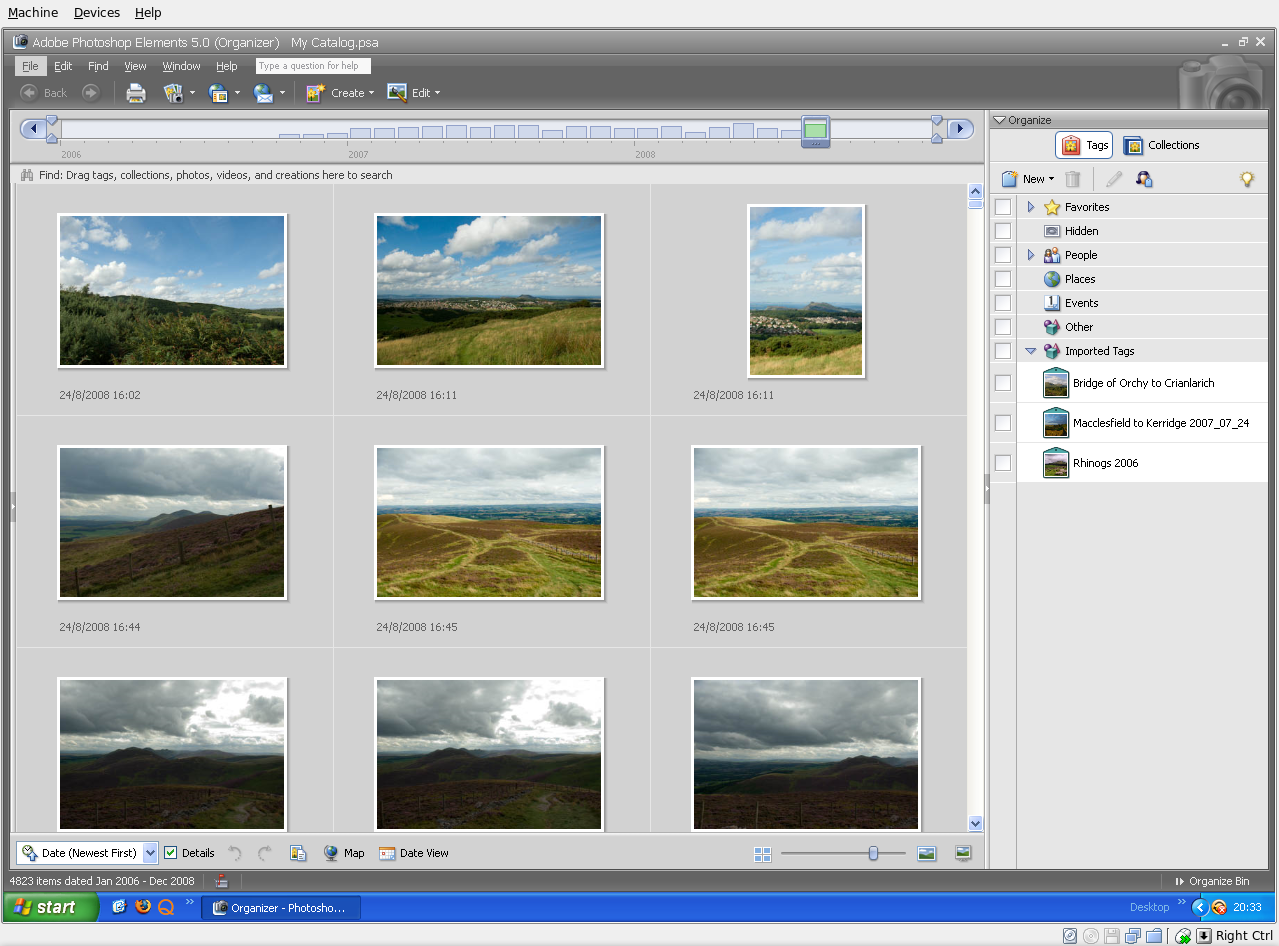
For one thing, its Shared Folders functionality doesn't trip up Photoshop Elements like VMware does. VMware so hobbled Photoshop's ability to save back to the Linux file system that it had me looking at the WINE route; I also got to use GIMP for a while. VirtualBox brought me back into the Photoshop fold, and I seem to like the results that I can get with Elements better than those from GIMP.
Another nicety is the way that guest OS desktops can be resized to fit in a maximised VM window. For this to work, you need VirtualBox Guest Additions in place in the virtual machine, but it works very well when all is in place; my experience is with Windows XP. Full screen is on tap too once you use the Host+F combination; the right hand control key is usually the Host key by default. If there is any criticism at all, it might be that seamless application windows are not available in OSE 1.5.6.
Linux kernel changes can upset things, but drivers don't take too long to appear, and you can always take matters into your own hands anyway. It's a far cry from the blithe indifference of VMware and the need to resort to vmware-any-any patching to get things under way again.
All in all, VirtualBox OSE treats me very well. Guest operating systems may seem sluggish at times, but it's never enough to annoy or seriously impede usage. It'll be interesting to see if a newer version of VirtualBox makes it into Ubuntu 8.10.
Removing files for which you have no write access from the GNOME Wastebasket in Ubuntu 8.04
2nd September 2008
It might be that GNOME contains a small trap awaiting the unwary: moving files for which you have no write permissions to the Wastebasket using Nautilus. This happened to me in Ubuntu 8.04 which meant that I couldn't clear the Wastebasket using the normal means. To resolve the situation, I thought of finding where the Wastebasket in the normal file system, and that isn't as easy as it might be. One place to look is ~/.Trash, but I didn't have that at all because the location in Hardy Heron is ~/.local/share/Trash/Files. Armed with this knowledge, I turned to the command line and performed the required erasure using sudo. It was all over soon enough once I knew where to look.